This is an approach I started building in 2026 and am still in the middle of. It has no results to report yet — no before-and-after numbers, no verdict. I’m writing it down because the reasoning behind it is the part I’d want to read from someone else, and because committing to it in public makes it harder for me to quietly move the goalposts later.
The short version: getting an AI agent to write code well is not mainly a prompting problem. The leverage isn’t in the prompt. It’s in the system that decides what the agent works on, what gate verifies the result, and what state survives between one run and the next. So instead of collecting prompting tricks, I’ve been building the system.
Why checking, not writing, is now the bottleneck
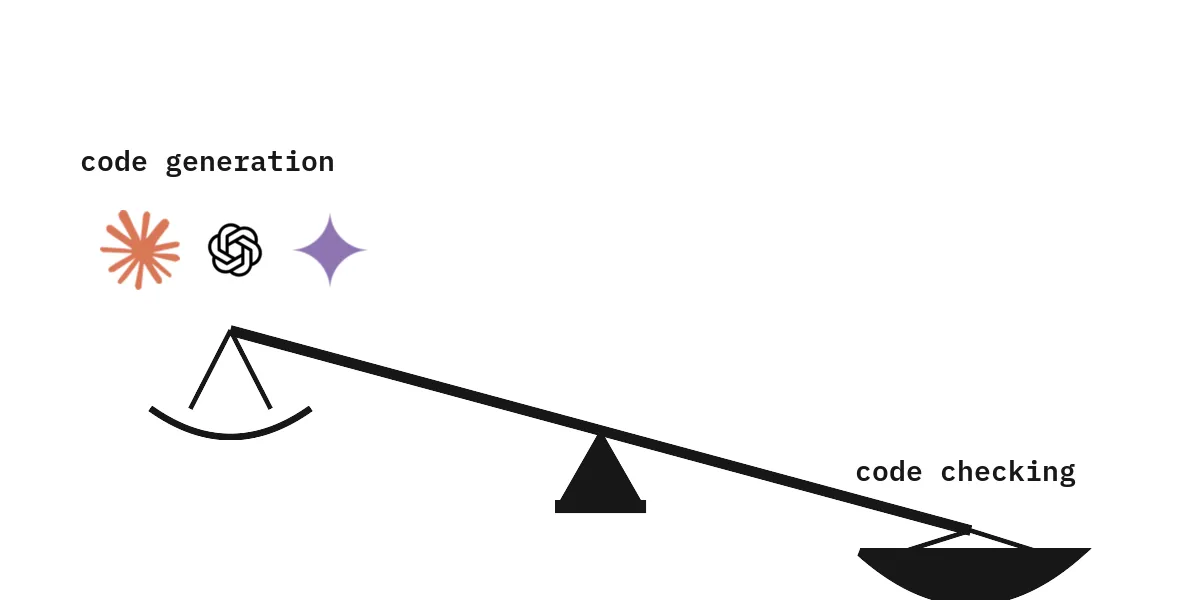
Producing code has become dramatically cheap. Checking it has not.
That sentence is the whole argument, so it’s worth being precise about why the second half is true. A model can hand me a coherent 400-line change in under a minute. Reading that change properly costs me exactly what it cost before — arguably more, because the failure mode has changed. Obviously-wrong code announces itself. Plausible-but-wrong code doesn’t: it compiles, it reads like something a competent person wrote, it passes the tests that exist, and it’s wrong in a way that requires knowing the intent to see. Volume went up, and the per-unit cost of verification went up with it.
So the bottleneck moved. The scarce resource is no longer typing, it’s attention — and attention doesn’t scale by adding agents. If the cost of production drops by an order of magnitude and the cost of verification doesn’t, then verification is where the whole thing either works or quietly fails.
There’s an obvious move here that doesn’t work: have a second agent review the first one’s code. I use maker/checker separation, but on its own, without an objective check underneath it, that arrangement is two optimists agreeing with each other. The model that wrote the code is a lenient judge of it, and a second model with no fixed standard to check against tends to find the work acceptable too. Agreement is not verification.
The practical consequence is that “done” has to be measurable rather than a judgement. Which means as much verification as possible has to stop being an act of reading and become an act of running.
Introducing Obrussa
Obrussa is a public repository of standards, architecture decision records and templates that every project of mine inherits, and it contains no product code — MIT licensed, so the template can be copied into anything, including closed source. The word is Latin, from the Greek obryza: the assaying of gold by fire. Aurum ad obrussam is gold refined to the highest purity, and Seneca uses ad obrussam figuratively for something that has been put to the test and proved genuine. It seemed like the right name for a system whose entire job is telling apart what is correct from what merely looks correct.
In concrete terms: architecture decision records covering the framework itself, a document on how to keep many repositories aligned without duplicating or contradicting each other, and a service template — the skeleton a new repo starts from, carrying a deliberately thin context file, the gate specification, a state file, a contract, and an empty skills folder waiting to be earned.
At the top of it sits the principle everything else is derived from: the leverage is no longer in the prompt, it’s in the system that decides what the agent works on, what gate verifies the result, and what state survives between runs. Everything below is what that turns into when you make it concrete.
Two tiers, split by what happens when a check is wrong
Tests check what you thought to check. That covers the code compiling, the happy path working, the cases someone imagined. What tests systematically miss is a different category:
- security that isn’t a functional bug — missing authorisation, an injection point where the happy path passes cleanly, careless secret handling;
- contradictions between modules — A assumes X, B assumes not-X, and each passes its own tests;
- code that is internally coherent and wrong with respect to the intent.
These don’t announce themselves per change. They accumulate invisibly and surface together, late, which is the most expensive moment available.
My first attempt at the gate sorted the checks into four levels: form, security, coherence, licensing. It looked tidy and it was the wrong cut, because it answered what gets checked and left open the only question that turns out to matter — what must never be left to a judgement. Those are different questions, and only the second one tells you where to spend.
So the gate has two tiers, and an invariant is assigned to one by the consequence of getting it wrong.
Tier one is deterministic and blocking, and it exists only for invariants where a false negative is catastrophic and irreversible. In most systems that list is short, and writing it down explicitly is most of the work: cross-tenant data access, a secret reaching a commit, something private crossing into something public, a licence boundary that may only be crossed one way. For these, a probabilistic guarantee is not a guarantee. They get fitness functions on the import graph, isolation tests, secret and dependency and licence scanning, strict types and lint. Never an LLM alone — a model may review them in addition, never instead.
Tier two is an LLM reading the standards as its rubric, and it covers everything that resists codification: architectural intent, whether a write really goes through a properly scoped use case, naming coherence, replay safety. A different model from the one that wrote the change.
The cut is by consequence, not by subject. The first attempt sorted checks by what they looked at, which left the only question that decides where to spend unanswered.
The rule fits on one line:
Catastrophic and irreversible → deterministic. Everything else → the rubric.
Two things follow from that, and they’re the parts I’d defend hardest.
The first is that the prose is the prompt. The reviewing model reads the standards documents themselves — not a checklist derived from them. Nothing gets translated, so there’s no second artefact to drift out of sync, and the standards earn their token cost twice: once as the rules a person argues with, once as the rubric a model applies. It also disciplines the writing, because a rule too vague to be applied by a model was too vague to be applied by a person and nobody had noticed.
The second is a small operational rule with a nasty failure mode behind it. A change to a standard that touches a deterministic check has to land in the same pull request as the change to its config. Otherwise the code stays green while obeying the rule you just replaced, and prose and enforcement part company silently. The gate guarantees code follows the standard; that rule is what keeps the standard and its enforcement together, and nothing automated catches it.
What the two tiers have in common is the same purpose as before: converting as much as possible into something CI can fail. What CI fails, nobody has to notice.
The number that decides whether this works
The metric I’m tracking is cost per accepted change: what it takes, end to end including my own review time, to get one change actually merged. Not lines produced, not tokens spent, not how impressive the diff looked.
That number is also the falsification condition, which matters to me more than Obrussa does. Below a certain acceptance rate, AI leverage is negative — you’re paying in review attention more than you’re saving in production. If that’s where the number lands, the honest response is to say so rather than to keep adding process. I’d rather have a metric that can tell me I’m wrong than a conviction that can’t.
And there is an irreducible share of human judgement that no gate absorbs. I handle it by risk-tiering rather than by pretending: authentication, payments, personal data and security boundaries get read line by line, by me. Everywhere else, the gate plus spot-checks is the deal. That’s an explicit trade, and writing it down is what makes it a trade instead of a drift.
Three kinds of memory, and one that’s deferred
The other half of Obrussa is what an agent knows when it starts. Three tiers, separated by cost and by when they load:
- Always-on context — vision, architecture, domain, threat model, the standards that apply, and the repo’s
CLAUDE.md. This describes what the system is and what the rules are. It loads every session, so it’s paid for in tokens every session, so it has to stay thin. It’s also the tier-two rubric, which is the argument for paying for it. - Skills — a procedure for something recurring, loaded on demand, able to carry scripts and reference material. This is where repeatable know-how goes precisely so it doesn’t bloat the always-on context.
- Dynamic state — a
STATE.mdsaying where the work currently is, updated as slices land.
The rule that keeps them apart: if it’s always true about the project, it belongs in context; if it’s how you do X when you need X, it belongs in a skill. Putting procedures in the always-on file is the token waste to avoid.
One thing I deliberately left out: a vector store. Product memory (RAG over a corpus) and coding-agent memory are different problems, and for the second one the codebase plus git plus native search already is the semantic memory. Adding retrieval infrastructure here would be solving a problem I don’t have.
Skills are also deliberately deferred. The empty skills/ folder ships in the template with a candidates file next to it, and nothing gets promoted into a skill until at least one manual run of that procedure has proved reliable. A skill written before that is an unverified hypothesis with the authority of documentation — it crystallises a convention nobody has tested. Order matters: foundations, then the gate, then the template, then a first service built in vertical slices under the gate, then skills extracted from whatever actually held.
Many repos, and the context you give up
The layout I use is hub and spoke: one private repo holding system-level documents, standards, versioned contracts and a service catalogue, plus one repo per service. That buys clean licence and visibility boundaries and costs something specific: an agent working in one repo cannot see the others. It will happily make an assumption about a neighbour that used to be true.
The substitute for the unified context you gave up is contracts published as versioned artefacts, with consumer/provider contract tests in the gate. That’s the machine-checkable replacement — it doesn’t inform the agent, it fails when the agent gets it wrong, which is the same outcome one step later. And the tedious job of keeping N repos on the same version of shared conventions is repetitive and machine-checkable, which makes it the honest place for an automated maintenance loop: a bot opening pull requests across repos when the standards change. Loops earn their place there, in maintenance, not in greenfield work where nobody can say what “correct” means yet.
Where Obrussa actually stands
Today it is a boilerplate and a set of decisions, being applied for the first time. The parts I believe most are the asymmetry argument and the insistence that “done” be measurable — those hold regardless of tooling. The part I’m least sure about is proportion: whether a solo developer can carry a deterministic tier plus contract tests plus a review pass without the ceremony eating the gain it was supposed to protect. Splitting the gate by consequence helps here more than it first appears — the expensive tier is the deterministic one, so keeping its list of invariants short is exactly what makes the thing affordable. That’s exactly what cost per accepted change is there to answer, and it’s a number I don’t have yet.
What I’m confident about is the shape of the problem. When producing a change becomes nearly free and verifying it doesn’t, everything that matters moves to the verification side. Prompting better doesn’t touch that. Building a system where correctness is checked by something that never gets tired, and where human attention is spent deliberately on the parts that deserve it, might.